
Waves
An Exploration.
Andy Zhao.

Oh no! There's a meteor shower over your pool!
Looks like the rocks are causing a bunch of waves to collide with each other!


Wave
Interference
Interference occurs when two waves collide with each other. It can either be destructive interference or constructive interference. The point of maximum constructive interference, where the energy builds on top of each other leading to an increased amplitude, occurs when two crests or troughs collide at the same time. The point of maximum destructive interferences, or when the energy of the wave cancels each other out leading to a decreased amplitude, occurs when a crest and a trough collide at the same time.
The Island Experience
You are on your dream vacation, floating on an inflatable in the protective space of a lagoon. You relax as the sandbank would seem to protect you from big waves. All of a sudden, you feel yourself rocking after a cruise chip passes by. What happened?
Turns out, the principle of diffraction is the reason for this. Wave diffraction occurs when a wave passes by a barrier or slit and changes direction. This is how waves can bend around barriers such as the slit in the sandbank and this is the reason why you are now falling off your inflatable.


The YEllow Submarine
Whoa! We're in a submarine now! Underwater and everything. In fact, the water that we are traveling through is the medium of the wave. In fact, it is the medium that a wave travels through that determines a wave's angle and velocity. In ocean waves, the deeper the water, the faster the wave travels.
Ahh! Fire!
Oh no! There is a fire coming from the kitchen in the submarine! Luckily, you knew about it because of the smoke detector, an invention made possible by taking advantage of the photoelectric effect. This is when electrons are emitted from a surface due to light hitting it. A smoke detector works by detecting the signature scattering of light produced by smoke from a fire.
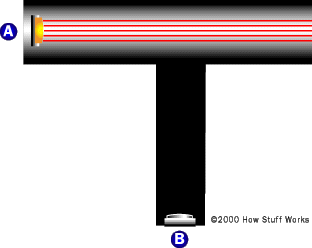
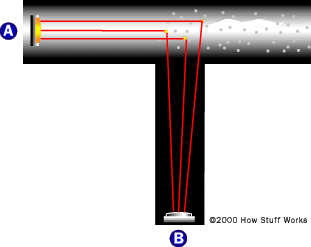
As can be seen, B is the light detector. With no smoke present, the light goes right past the detector. However, with smoke from a fire, the smoke causes the light to scatter and hit the light detector, causing it to release electrons because of the photoelectric effect and complete the circuit, sounding the alarm.